Why switch from stainless steel to single-use technology? The question now shapes many biopharmaceutical manufacturing strategies. It is not a simple equipment replacement. It involves process design, contamination control, facility planning, operator training, and long-term cost analysis.
Dr. Mark Witcher, a recognized bioprocessing consultant and author, has described the decision clearly: “Single-use technology is a tool, not a religion.” That perspective matters. Single-use bags, tubing, and bioreactor components can reduce cleaning requirements and shorten changeover time. They may also support faster facility commissioning and more flexible production campaigns. In practical terms, operators can replace a disposable flow path instead of inspecting a large stainless-steel vessel after every batch.
The benefits are not automatic. Plastic components require careful extractables and leachables assessment. Supply continuity also deserves close attention. A delayed bag shipment can disrupt a carefully planned schedule. Waste management presents another concern, especially for facilities seeking stronger sustainability performance. These limitations should remain visible.
The strongest decision usually comes from evidence. Teams should compare validated process performance, labor, water consumption, energy use, facility size, and lifecycle costs. They should also consider product scale and future demand. A single-use system may be highly effective for clinical or multi-product manufacturing, but less suitable for every high-volume operation.
There is no universal answer. That is the uncomfortable part. A thoughtful comparison, supported by engineering data and operator experience, creates a more reliable path than following industry fashion.
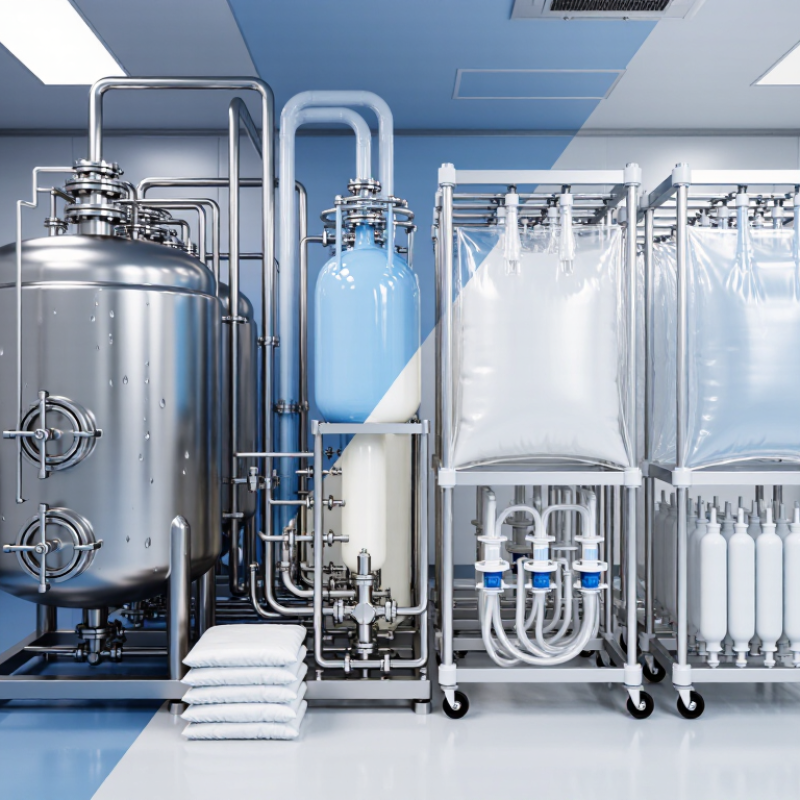
Why Switch From Stainless Steel to Single-Use Technology?
Single-Use Technology: Definition and 2023 Bioprocessing Market Data
Single-use technology uses disposable bags, tubing, filters, and connectors instead of permanently installed steel vessels. These components arrive pre-sterilized and support one manufacturing campaign. After processing, operators remove and discard them. The approach can reduce cleaning, validation, and changeover requirements. It also lowers the risk of product carryover between batches.
Market data shows strong adoption. Grand View Research estimated the global single-use bioprocessing market at approximately USD 7.05 billion in 2023. Its report projected a 17.6% compound annual growth rate from 2024 to 2030. MarketsandMarkets reported a different 2023 estimate, near USD 6.1 billion. The difference reflects varying definitions, regions, and product categories. Still, both reports indicate rapid expansion.
The operational benefits are practical. A facility can install a disposable mixing bag without building a dedicated cleaning loop. This may shorten commissioning time and reduce water consumption. Smaller production teams also gain flexibility when manufacturing several products. However, single-use systems create new concerns. Plastic waste, supply continuity, extractables, and connection failures require careful controls. The 2023 BioPlan Associates industry report also described continued investment in single-use manufacturing capacity and process flexibility. Yet adoption is not automatically safer or cheaper. A poorly designed setup can increase waste and handling risks. Stainless steel remains valuable for high-volume, long-term production. The better choice depends on batch size, facility design, product sensitivity, and lifecycle calculations.
| Evaluation Dimension | Stainless-Steel Bioprocessing | Single-Use Technology | Relevant Fact or 2023 Market Indicator |
|---|---|---|---|
| Definition | Permanent equipment with reusable product-contact surfaces, commonly manufactured from 316L stainless steel. | Disposable or single-batch product-contact assemblies, such as bags, tubing, filters, and connectors, used once and then discarded. | Single-use systems are designed to reduce or eliminate cleaning and sterilization of product-contact equipment between batches. |
| Typical Bioreactor Scale | Well suited to large, repeated production campaigns, including commercial-scale vessels above 2,000 L. | Commonly used from laboratory and process-development volumes through approximately 2,000 L working volume. | The practical upper limit depends on vessel design, film technology, mixing requirements, and process type; 2,000 L is a widely used commercial reference point for disposable bioreactors. |
| Changeover Time | Requires cleaning, inspection, preparation, and often clean-in-place and steam-in-place procedures before reuse. | Changeover generally involves removing the used assembly and installing a preassembled, sterilized assembly. | Single-use processing can shorten turnaround time because post-batch cleaning and steam sterilization of the product-contact path are avoided. |
| Cleaning and Sterilization | Requires validated cleaning procedures and, where applicable, validated steam-in-place cycles. | Assemblies are commonly supplied presterilized, often using gamma irradiation or another validated sterilization method. | The validation focus shifts from cleaning-cycle effectiveness to supplier controls, sterilization assurance, assembly integrity, and compatibility with the process. |
| Cross-Contamination Risk | Risk is controlled through validated cleaning, inspection, maintenance, and segregation procedures. | Reduced carryover risk New product-contact components are used for each batch. | Single-use technology is particularly attractive for multiproduct facilities and products manufactured in smaller or changing batch sizes. |
| Water and Utility Demand | Typically requires significant quantities of purified water, water for injection, clean steam, and energy for cleaning and sterilization. | Usually reduces process-water, clean-steam, and energy demand associated with cleaning and sterilization. | The environmental trade-off is a higher volume of solid polymer waste, so life-cycle assessments should include manufacturing, transport, disposal, and energy sources. |
| Facility Construction | Needs fixed vessels, piping, utility distribution, drainage, cleaning systems, and sterilization infrastructure. | Can support smaller facility footprints and more modular layouts because extensive fixed piping and cleaning infrastructure may be reduced. | Facility savings depend on the process, scale, automation level, HVAC design, and the extent to which stainless-steel equipment is replaced. |
| Capital Investment | Higher initial investment is common because of permanent vessels, utility systems, cleaning systems, and installation requirements. | Often lowers initial facility and equipment investment, although recurring consumable costs are higher. | The economic advantage is strongest for multiproduct, clinical, small-batch, and rapidly changing manufacturing operations. |
| Operational Cost Profile | Lower recurring product-contact consumable costs, but higher cleaning, maintenance, validation, and utility costs. | Higher recurring costs for bags, tubing, filters, sensors, connectors, and assemblies, with lower cleaning-related costs. | Total cost of ownership should include labor, water, energy, facility depreciation, waste treatment, downtime, and batch-changeover requirements. |
| Extractables and Leachables | Generally associated with metal-contact surfaces, elastomers, gaskets, and other components in the fluid path. | Requires assessment of chemicals that may migrate from polymer films, tubing, filters, adhesives, and connectors into the process stream. | Extractables and leachables evaluation is a core qualification requirement for disposable assemblies and must be matched to process conditions. |
| Supply-Chain Dependency | Relies mainly on equipment maintenance, spare parts, and utility-system availability after installation. | Depends on consistent availability of qualified films, tubing, filters, sensors, connectors, and custom assemblies. | Supply continuity, dual sourcing, inventory planning, and component standardization are important risk controls for single-use operations. |
| Waste Profile | Generates less disposable plastic waste but produces wastewater, spent cleaning chemicals, and emissions from utility generation. | Generates solid polymer waste after each batch, with disposal routes varying by local regulation and facility capability. | Neither platform is universally superior environmentally; the appropriate choice depends on batch frequency, facility utilization, water intensity, energy mix, and waste treatment. |
| 2023 Market Direction | Remained important for high-volume, standardized, long-running manufacturing campaigns. | Continued expanding in biologics development, clinical manufacturing, cell and gene therapy, and flexible multiproduct facilities. | Published 2023 market studies commonly placed the global single-use bioprocessing market in the approximate range of US$5–7 billion, with many forecasts projecting a mid-to-high-teens compound annual growth rate through 2030. Estimates vary by scope and included product categories. |
| Best-Fit Use Case | Large-volume products with stable demand, high equipment utilization, and well-established recipes. | Multiple products, smaller or variable batches, accelerated development, clinical supply, and processes requiring rapid changeover. | Hybrid facilities are common: stainless steel may be retained for utilities or large-scale steps, while single-use equipment is used for upstream, downstream, or transfer operations. |
Note: Market figures are rounded ranges synthesized from publicly available 2023 industry market assessments. Definitions, market boundaries, geographic coverage, and forecast assumptions differ among studies; therefore, the range should be used as an indicative market benchmark rather than a single audited value.
It uses disposable bags, tubing, filters, and connectors instead of permanent steel vessels. These components arrive pre-sterilized and support one manufacturing campaign. After processing, operators remove and discard them.
Single-use systems can reduce cleaning, validation, and changeover work. Operators may connect the prepared flow path and begin processing. Less cleaning. Fewer handoffs.
Stainless steel systems require draining, washing, inspection, and reassembly. Single-use assemblies usually require connection checks and leak checks. One missed clamp can still cause hours of delay.
They may reduce the need for cleaning tanks, rinse-water loops, and drying areas. They can also lower demand for steam and purified water. The warehouse still needs space.
Track connection time, avoided cleaning hours, operator steps, deviations, and discarded materials. Check tubing, filters, and bags against pressure and temperature limits. Measure real campaigns, not assumptions.
No. Disposal, storage, waste handling, and supply continuity affect total cost. A poorly designed process may increase waste and handling risks. Cheaper equipment is not always cheaper operation.
Users should assess plastic waste, extractables, connection failures, and material availability. Training must cover connections, clamp placement, and leak detection. It is not risk-free.
Published estimates placed the global market near 6.1 to 7.05 billion dollars in 2023. One forecast indicated about 17.6% annual growth from 2024 through 2030. Different methods produce different figures.
Yes. Stainless steel remains valuable for high-volume, long-term production. The better option depends on batch size, facility design, product sensitivity, and lifecycle costs. A hybrid process may fit better.
Why switch from stainless steel to single-use technology? In modern bioprocessing, single-use systems are increasingly adopted because they combine flexible production with simpler facility operations. 2023 market data reflected continued growth in single-use equipment and components, driven by demand for faster development, smaller production batches, and more adaptable manufacturing capacity. Unlike fixed stainless-steel systems, disposable assemblies can reduce cleaning and sterilization requirements, helping facilities save substantial amounts of water and energy; some industry reports have indicated water-use reductions of up to 80%, depending on the process.
Single-use technology can also improve sterility assurance by lowering cleaning-related risks and reducing opportunities for cross-contamination. Faster changeovers, less maintenance, and smaller facility requirements may improve operational efficiency and shorten production timelines. However, implementation involves trade-offs, including dependence on reliable material supply, the need for responsible waste management, and possible limitations when scaling to very large volumes. A balanced assessment of process needs, sustainability goals, supply resilience, and production scale is therefore essential before making the transition.

 U-Care Medical